

End-to-End BMS Testing Solution
End-to-End BMS Testing Solution:
From HiL to Virtual Verification, Empowering Automotive, Energy Storage, Marine, and eVTOL Applications
I. Diversified Development of BMS: Testing Faces New Challenges
The battery is the "heart" of new energy vehicles, while the BMS is the core that ensures the safe operation of the battery and the release of its comprehensive performance. With the rapid iteration of new energy technologies, BMS is expanding from a single automotive application to multiple fields, and its functions are also extending from basic energy control and status monitoring to multiple dimensions such as complex safety protection, thermal management, and cross-domain collaboration.
For the same battery pack, different BMS algorithms and control strategies may ultimately lead to vastly different performance in terms of range, lifespan, and safety. Moreover, when it comes to batteries, automakers generally have more limited choices, such as battery capacity and battery type. However, they have decision-making authority over different BMS energy control methods or functional management methods. This is why both automakers and battery manufacturers are now investing substantial resources in BMS R&D and testing.
Currently, BMS testing is facing four core challenges:
· Safety testing scenarios are increasing sharply: extreme scenario testing such as thermal runaway protection, high-voltage safety, and collision protection has become a rigid requirement, significantly increasing testing complexity.
· Software iteration is accelerating at an unprecedented pace: OTA updates, charging and discharging strategy optimization, fault diagnosis upgrades, and other factors lead to frequent functional changes, multiplying testing pressure.
· R&D cycles continue to be compressed: shift-left testing has become an inevitable trend, and virtual verification technology is being widely applied.
· Overseas export requirements: as Chinese new energy companies accelerate their overseas expansion, BMS must also meet international safety certification standards such as IEC 62619 and ISO 26262, as well as regional access requirements such as EU CE and North American UL. It must also have virtual sample delivery capabilities.
II. End-to-End BMS Testing Solutions Under Diversified Development
In response to the development trends of BMS in the automotive industry, Polelink has built a full-level testing system ranging from the software level (MiL/SiL/PiL), to a single controller (HiL), and then to three-electric-system integration. The system covers the full lifecycle of BMS development and verification, and the entire process is connected to the CI/CT pipeline, enabling full automation from code submission to test delivery. This greatly shortens the testing cycle while realizing continuous integration and continuous testing.
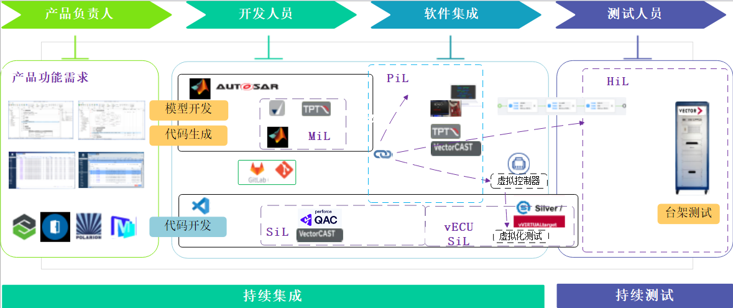
1. PRAXLINK.GREEN BMS HiL Testing System
Polelink has launched the BMS HiL testing system under the PRAXLINK.GREEN brand. It consists of three parts: a test management platform, test software, and test hardware:
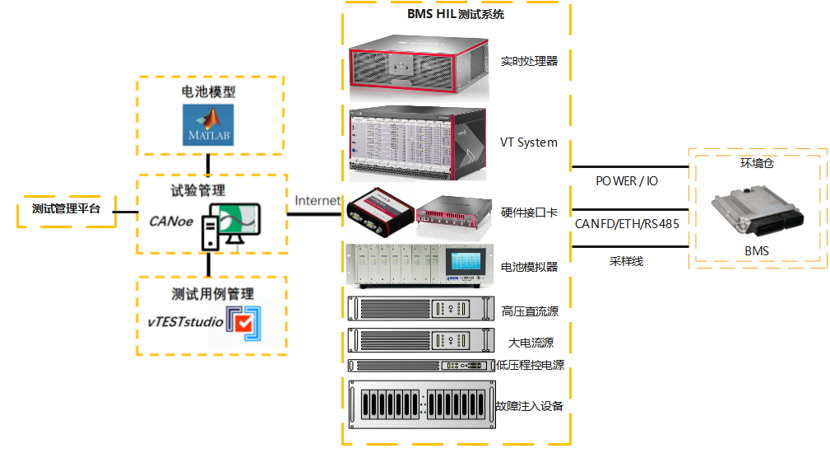
PRAXLINK.GREEN BMS HiL Testing System
· Test management platform: realizes full-process management including test requirement analysis, test case management, task scheduling, and statistical analysis, and supports integration with third-party tools such as Jenkins, Polarion, and Feishu.
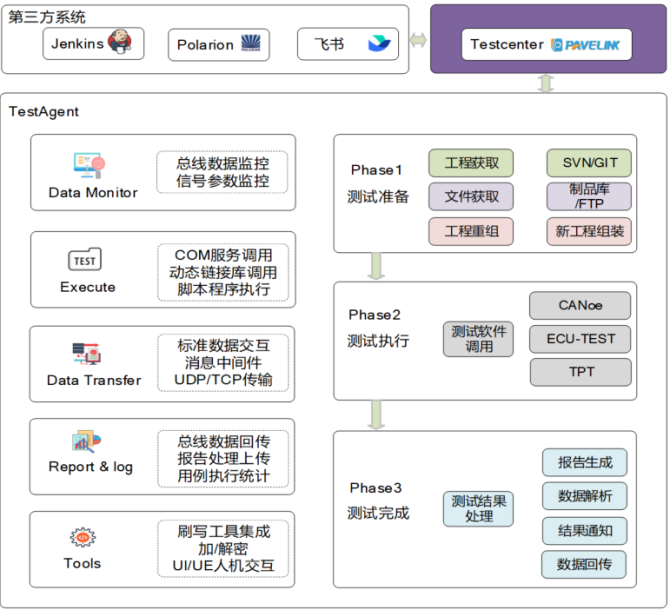
Test Management Platform
· Test software: with Vector CANoe and vTESTstudio as the core, combined with high-precision battery models, it provides automated test case development and execution capabilities.
· Test hardware: integrates hardware such as Vector VT System, battery simulators, high-voltage power supplies, and fault injection devices, and can simulate various operating conditions including cell voltage, temperature, and insulation resistance.
The testing system can fully cover various BMS testing scenarios:
· Logical function testing: charge and discharge control, sampling accuracy, SOX estimation, balancing management, thermal management, and more.
· Functional safety testing: complies with the ISO 26262 standard, verifies the safety response capability of BMS under fault conditions, and ensures that diagnostic coverage meets ASIL-C/D level requirements.
· DC charging testing: fully supports the latest GB/T 27930.2-2024 standard, enabling charging interoperability and protocol conformance testing, as well as backward compatibility with older charging versions.
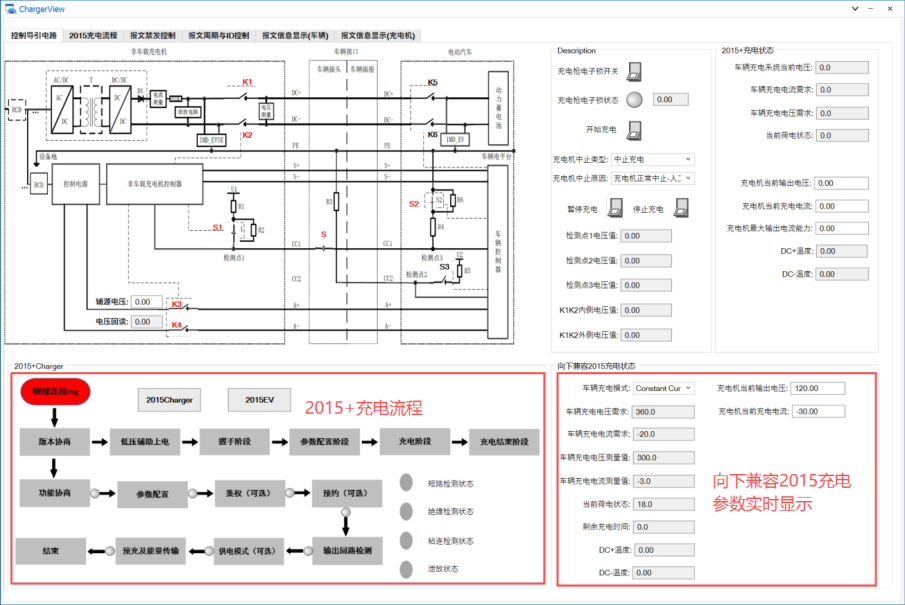
CANoe Interface for DC Charging Testing
· Communication and diagnostic testing: supports CAN/CANFD/LIN buses, UDS diagnostics, network management, flashing tests, and more.
2. Testing Extension: System-Level Functional Testing Solution
It can be extended to three-electric-system integrated testing of BMS/VCU/MCU/OBC DCDC, verifying functional interaction and signal consistency among controllers. Vector’s VT5838 FPGA board is used to run customized motor and inverter models, which can simulate motor speed and torque signals for the MCU. The grid simulator simulates AC charging and abnormal grid fluctuations for testing OBC DCDC, while a power analyzer is used to collect related voltage and current data. The environmental chamber can simulate different external temperature and humidity environments. Various whole-vehicle operating conditions can be reproduced in the laboratory, enabling early identification of system integration issues and shortening the vehicle debugging cycle.
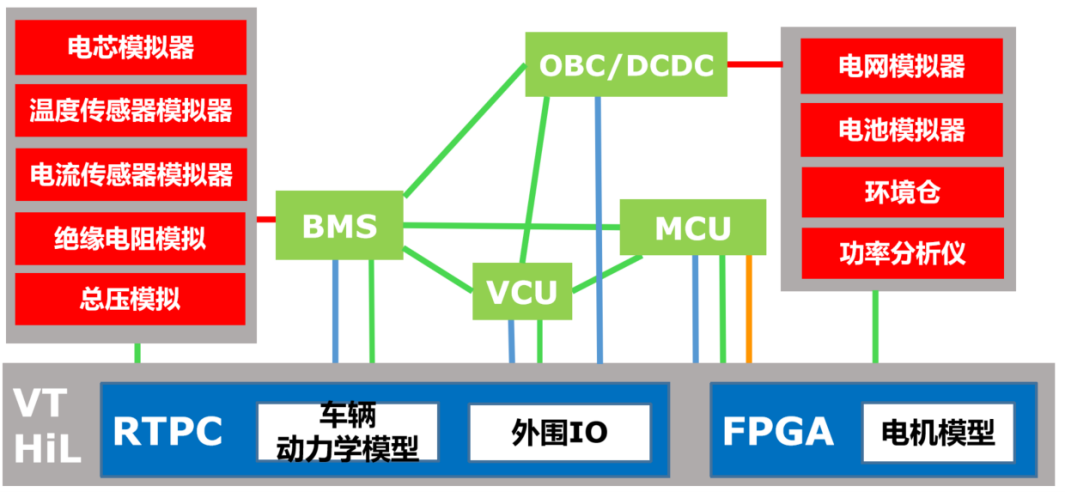
Three-Electric-System Integrated Testing Solution
3. Shift-Left Testing: BMS Virtual Controller SiL Virtual Verification Solution
Against the background of rapid BMS software iteration, the traditional approach of relying on physical controllers and bench environments for verification can no longer meet the efficiency requirements of algorithm development, software integration, and version regression. Especially in the early stages of a project, hardware samples are not yet ready and bench resources are limited, while BMS functions such as SOC/SOH estimation, charge and discharge control, thermal management, fault diagnosis, and communication interaction require frequent iteration. This makes shift-left testing an inevitable trend.
Polelink recommends a BMS SiL software-in-the-loop virtual verification solution that builds a vECU virtual controller to enable shift-left testing. In the early stage of a project, a Level 1 vECU can be generated, allowing BMS application software and key control logic to run on a PC-based virtual verification simulation platform, with SiL system integration completed through CANoe. This solution can build a complete external closed-loop environment around the BMS controller. The plant model may include a battery model, powertrain model, virtual bus, and counterpart virtual controllers, including external virtual controllers such as VCU, OBC, DCDC, and TMS or residual bus models. In this way, the operating conditions of the BMS can be simulated in a PC environment to verify control software strategies and calibration data.
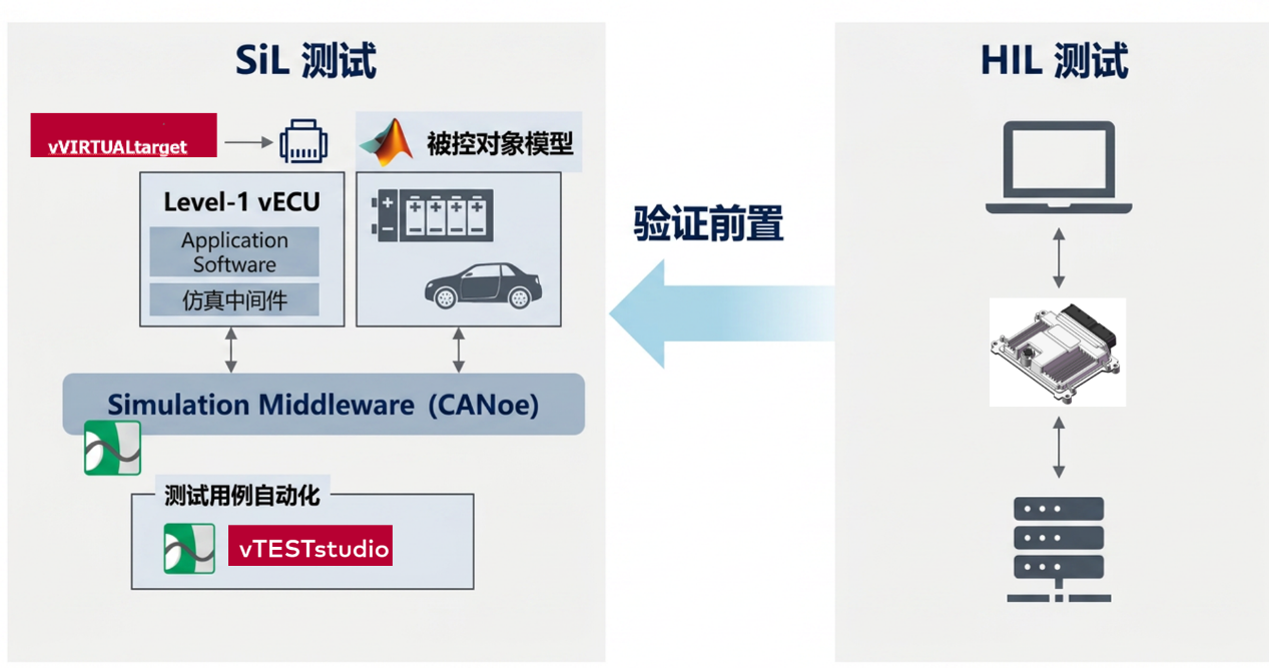
BMS Virtual Verification Architecture Topology Diagram
Based on this SiL virtual verification environment, test engineers can conduct software verification before hardware samples are in place. For example, they can perform multi-condition verification simulations for control algorithms such as SOC/SOH and inject previous real bench test data; they can verify the functional logic of charging and discharging processes and thermal management strategies; they can also debug control logic and interface consistency, automate test scripts, and execute automated test cases.
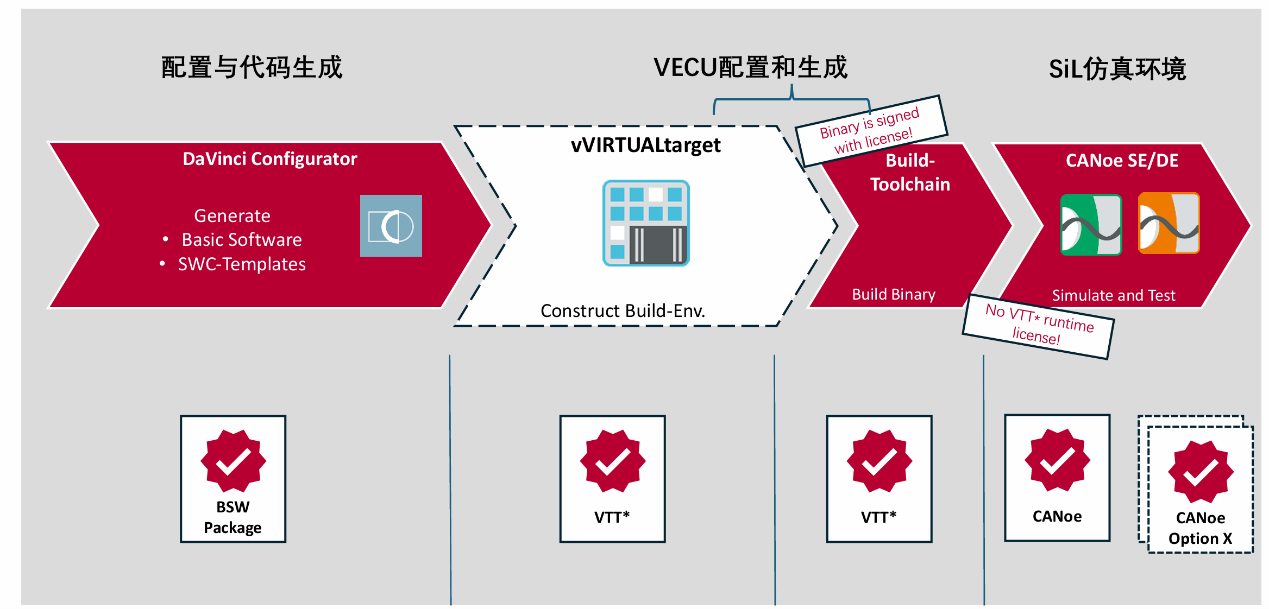
Example of Virtual Controller Generation Process
Compared with HiL testing, SiL is more suitable for taking on shift-left verification tasks such as software logic, algorithm strategies, communication interfaces, and large-scale regression testing. HiL continues to be used for real controller hardware, I/O sampling, electrical fault injection, and real-time scenario verification. The two complement each other, forming a continuous verification chain from software to hardware and from virtual to physical.
In terms of engineering implementation, Polelink’s virtual verification solution provides open integration capabilities. It supports the integration of customers’ existing battery models, vehicle plant models, and test case assets; supports integration with mainstream modeling and simulation tools such as DYNA4 and Simulink; is compatible with CANape measurement and calibration tools commonly used by calibration and software engineers in real-world scenarios; and can connect with test automation tools such as vTESTstudio or ECU-TEST. At the same time, Polelink can connect to the CI/CT pipeline according to customers’ existing R&D processes, enabling automatic build, automatic execution, and automatic test report generation after code submission, supporting continuous integration and continuous verification of BMS software versions.
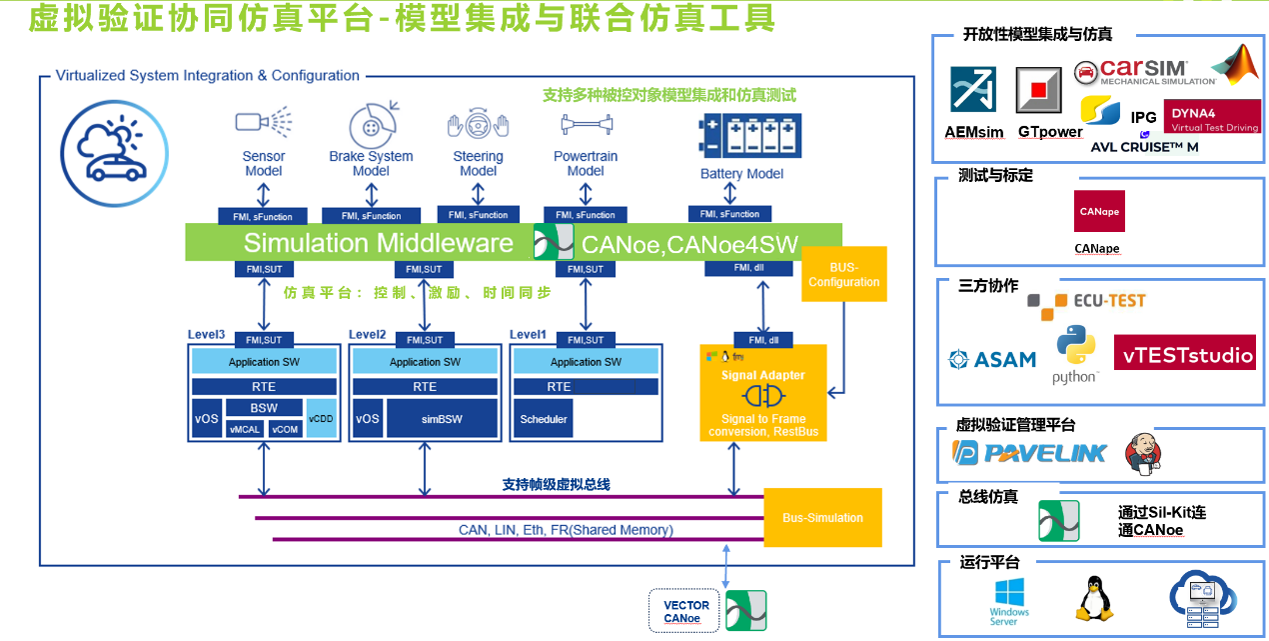
CANoe-Based Virtual Verification Co-Simulation Ecosystem
Through SiL virtual verification, BMS testing no longer depends entirely on physical samples and laboratory resources. Instead, a large amount of algorithm verification, software integration, and regression testing can be shifted to the early stage of development. This not only helps shorten the problem discovery cycle and reduce bench resource occupation, but also enables the accumulation of reusable model assets, test case assets, and automated script assets, providing a higher-quality software foundation for subsequent HiL, bench, and real-vehicle verification.
III. Multi-Industry Expansion: Empowering Energy Storage, Marine, and eVTOL
With the popularization of new energy technologies, the application scenarios of BMS are no longer limited to the automotive industry. Based on mature automotive BMS testing technologies, Polelink has successfully expanded them to multiple fields such as energy storage, electric vessels, and eVTOL.
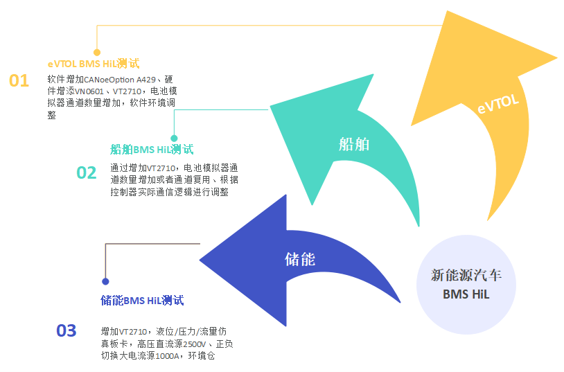
BMS HiL Testing System Expansion
1. Energy Storage BMS HiL Testing
In response to the explosive growth in demand for large-scale energy storage power stations and commercial and industrial energy storage, Polelink has launched an energy storage BMS HiL testing solution that complies with the GB/T 34131-2023 standard:
· 2500V high-voltage DC source and ±1000A high-current source, meeting the testing requirements of large-capacity energy storage systems.
· Multiple communication interfaces including CAN, RS485, and Ethernet.
· Simulation of special sensor signals such as liquid level, pressure, and flow.
· Wide-temperature environmental adaptability testing from -70°C to 180°C.
2. Marine BMS HiL Testing
In response to the development requirements of green vessels, Polelink has built a marine BMS testing solution that meets the Guidelines for the Recognition of Land-Based Joint Commissioning Organizations for Power Systems of Pure Battery-Powered Vessels. Before whole-vessel assembly, this solution can verify the communication and functional interaction between BMS and controllers such as MCU and EMS, ensuring the safe and reliable operation of the vessel power system.
3. eVTOL BMS HiL Testing
With the full liberalization of low-altitude economy policies, eVTOL is entering a critical period for airworthiness certification and commercial implementation. Polelink’s eVTOL BMS testing solution meets civil aviation airworthiness standards such as CCAR-27/29, DO-178C, and DO-160G, and supports:
· ARINC 429/825 aviation bus communication.
· Aviation-grade special function testing such as redundant power supply switching.
· A high-performance real-time processor with 24 cores and a turbo frequency of up to 5.2GHz, meeting high real-time requirements.
· Special sensor signals including RS232, RS485, RS422, PSI5, SENT, SPI, I2C, and more.
IV. Summary
Polelink has been deeply engaged in automotive electronics testing for nearly two decades and has built an end-to-end testing system covering the full lifecycle of BMS. With the PRAXLINK.GREEN BMS HiL system at its core, it improves efficiency through virtual verification solutions and CI/CT automation while meeting stringent certification standards in China and overseas. It has also extended its mature technologies to emerging fields such as energy storage, electric vessels, and eVTOL, adapting to the differentiated needs of various industries.