

Intelligent Chassis Testing Solution
Overview
In the era of Intelligent Chassis 3.0, drive-by-wire, integration, and high safety have become core technological trends. The chassis domain controller centrally coordinates actuators such as steering, braking, suspension, and driving, which significantly increases system complexity, data interaction volume, and safety risks.
Traditional bench testing and real vehicle testing are no longer sufficient to cover key scenarios such as redundant control, fail-operational degradation, multi-system coordination, and extreme road conditions.
Leveraging years of experience in the automotive electronics industry, Polelink has developed PRAXLINK.DRIVE,
a Hardware-in-the-Loop (HiL) testing sub-brand focused on vehicle control and chassis systems. Its intelligent chassis testing solution is built around the core concept of combining "virtual" and "real" :
On the one hand, a HiL testing system is established. With four core capabilities—real-time simulation, software-hardware closed-loop, fault reproduction, and automated verification—it can fully reproduce real operating conditions such as brake-by-wire, steer-by-wire, suspension control, and chassis domain coordination in a laboratory environment. It strictly aligns with ISO 26262 functional safety and Safety of the Intended Functionality (SOTIF) requirements, providing full-process, highly reliable, and traceable validation support for intelligent chassis systems from algorithm design to mass production delivery.
On the other hand, virtualization testing methods are adopted to shift testing earlier in the development process, effectively shortening development cycles and reducing testing costs.
With the release of mandatory standards such as GB 21670-2025 "Technical Requirements and Test Methods for Passenger Car Braking Systems" and GB 17675-2025 "Basic Requirements for Automotive Steering Systems", drive-by-wire chassis (X-by-Wire), characterized by mechanical decoupling and direct electronic signal actuation, face higher testing requirements under the Intelligent Chassis 3.0 architecture.
The PRAXLINK.DRIVE intelligent chassis HiL testing solution builds a closed-loop validation environment highly consistent with real vehicles through high-precision vehicle dynamics models, real-time hardware I/O interfaces, load simulation, and fault injection units. It enables comprehensive validation of chassis control algorithms, communication interactions, fault responses, and redundancy strategies, ensuring stable and safe control performance under normal, extreme, and various failure conditions.
At the same time, this testing solution strictly follows chassis functional safety requirements and supports validation from ASIL-B to ASIL-D levels. It systematically enables fault injection and evaluation for signal faults, power faults, communication faults, and actuator failures, achieving reusable test cases, automated testing processes, and traceable test results. This significantly reduces real vehicle testing risks, shortens development cycles, and ensures the functional safety and operational reliability of intelligent drive-by-wire chassis systems. It is an essential core testing support system for the development and mass production of Intelligent Chassis 3.0.
Steering System HiL Testing Solution
Based on the Vector toolchain and combined with the German MdynamiX steering assembly mechanical test bench, this solution enables functional and performance testing of Electric Power Steering (EPS) systems and Steer-by-Wire (SBW) systems.
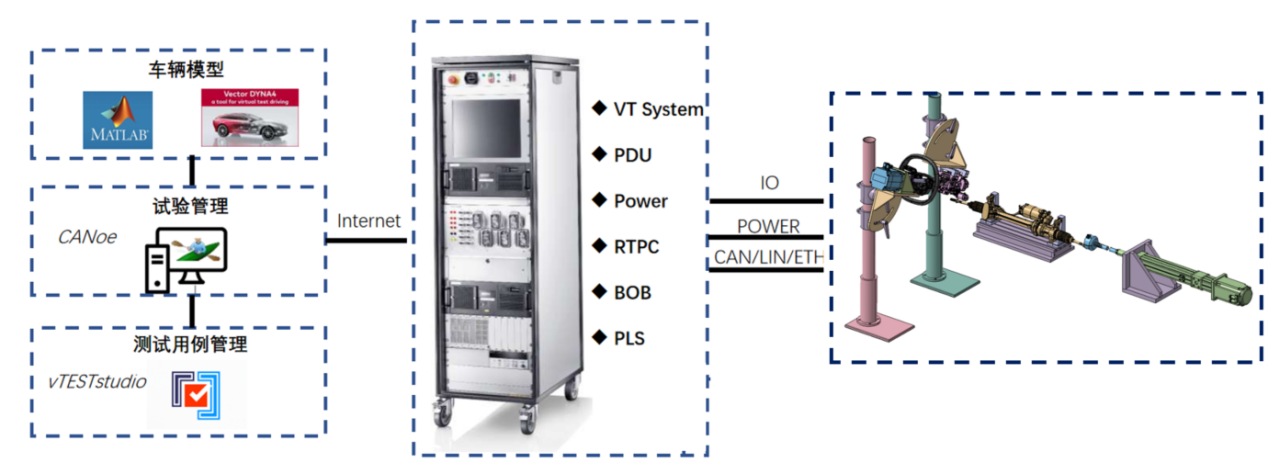
Solution Composition
Software Platform:
- CANoe (test management software)
- vTESTstudio (automated test case management software)
- DYNA4 (vehicle dynamics modeling software)
Hardware Platform:
- Real-time processor (RTPC)
- General I/O boards (VT/VIO System)
- Bus communication boards
- Programmable power supplies
- Dedicated chassis sensor simulation equipment (SENT/SPC/PSI5/wheel speed, etc.)
- Fault injection boards
Mechanical Test Benches:
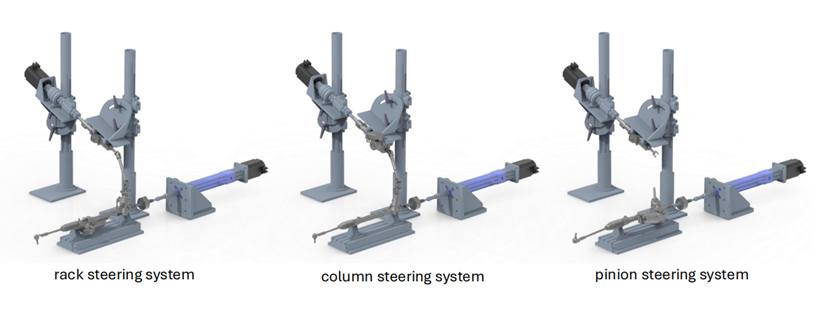
- Steering assembly test bench
- Steer-by-wire test bench
- PPK motor back-to-back test bench
Test Scope:
- Characteristic testing
- Performance testing
- Functional testing
- Durability testing
Mechanical Steering Test Benches for Different EPS Types (R-EPS / C-EPS / P-EPS / SBW)
Braking System HiL Testing Solution
Based on the Vector toolchain and combined with a project-specific customized braking assembly mechanical test bench, this solution enables closed-loop functional testing of electro-hydraulic braking systems (One-box / Two-box) and electro-mechanical braking systems (EMB).
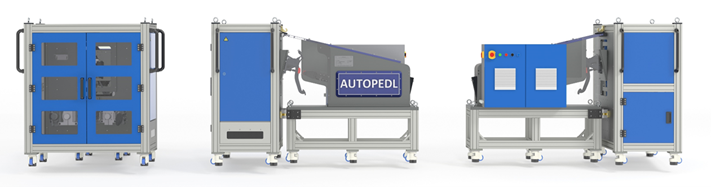
The braking test bench consists of a braking robot and a caliper load installation wet cabinet.
The electric cylinder of the braking robot simulates the driver’s brake pedal travel. The wet cabinet integrates the brake controller and actuators, and is equipped with hydraulic pressure sensors, EPB clamping force sensors, EPB current sensors, EMB clamping force sensors, and other components to collect signals required for closed-loop interaction with the dynamics model.
Suspension System HiL Testing Solution
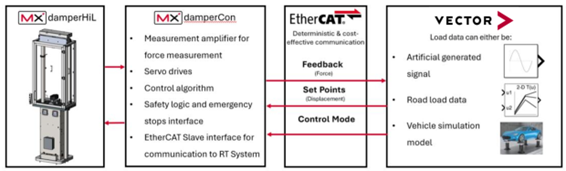
Based on the Vector toolchain and combined with the MdynamiX four-post suspension mechanical test bench, this solution is designed as a mechanical-level suspension HiL testing solution for semi-active or active suspension systems.
At the same time, Polelink can also provide a low-cost signal-level HiL testing solution for air suspension or variable damping (CDC) function testing.
Virtualization Testing Solution
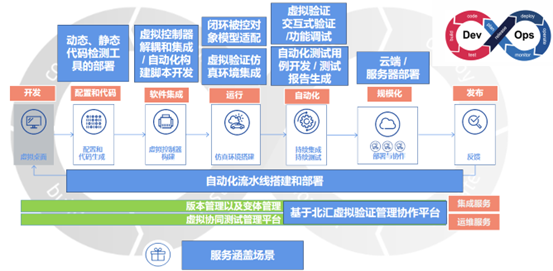
Introducing virtualization testing into chassis controllers is a key approach to achieving shift-left testing and improving cost efficiency.
Through simulation acceleration, parallel testing, early defect interception, and optimization of software and hardware costs, it can efficiently support high-frequency regression and multi-version iterations, shorten the overall development cycle, reduce hardware dependency and rework losses, and comprehensively improve the R&D quality and project execution efficiency of chassis electronic control systems.
Based on a purely software-based virtual simulation environment, controller logic, strategies, and functional validation can be carried out in advance without relying on physical hardware, enabling parallel development and testing.
It supports accelerated simulation execution and long-duration automated continuous testing, overcoming the time and space limitations of real vehicles and physical test benches, significantly shortening single test cycles and reducing the overall iteration time of chassis controller development.
Polelink can build and deploy automated pipelines based on a virtual validation management collaboration platform.
Polelink Advantages
- Modular software development platform ensures a consistent and stable early-stage development environment
- Installation positions are adjusted based on real vehicles, enabling results closer to real vehicle testing
- Various combinations and parameter ranges of linear motion motors, benefiting from precise control of torque, angle, rack force, and position, enabling accurate real-time testing results
- Customized vehicle model parameters to build a closed-loop HiL testing environment close to real vehicle conditions
- Flexible and open steering test bench, allowing users to easily adjust and switch controllers and ECU interfaces according to specific requirements, and enabling early-stage testing combining electric steering controllers with autonomous driving functions
- Easily convertible into a steering simulator for early-stage driving feel analysis
- Integrated testing of steering, braking, and suspension coupling functions
- Vector toolchain provides reliable support for multi-bus interaction scenarios such as CAN/CAN FD/FlexRay/Automotive Ethernet in domain control environments
Summary
For chassis system development and testing processes, Polelink provides a complete end-to-end testing solution, including:
- MiL, SiL, and PiL testing for development stages
- HiL and ViL testing for validation stages
Polelink can provide comprehensive technical support services in the field of chassis system testing platforms, including:
- Customized solution design and test bench selection consulting
- Development and parameterization experience sharing from control systems, steering models, braking models, and suspension models to full vehicle models
- Turnkey services with semi-physical closed-loop simulation testing integrated with existing chassis system assemblies
- Testing service consulting and test bench maintenance
- Development of new steering systems or new control strategies
- Outsourced testing services