

Why Automotive Controller Verification is Accelerating its "Shift-Left"
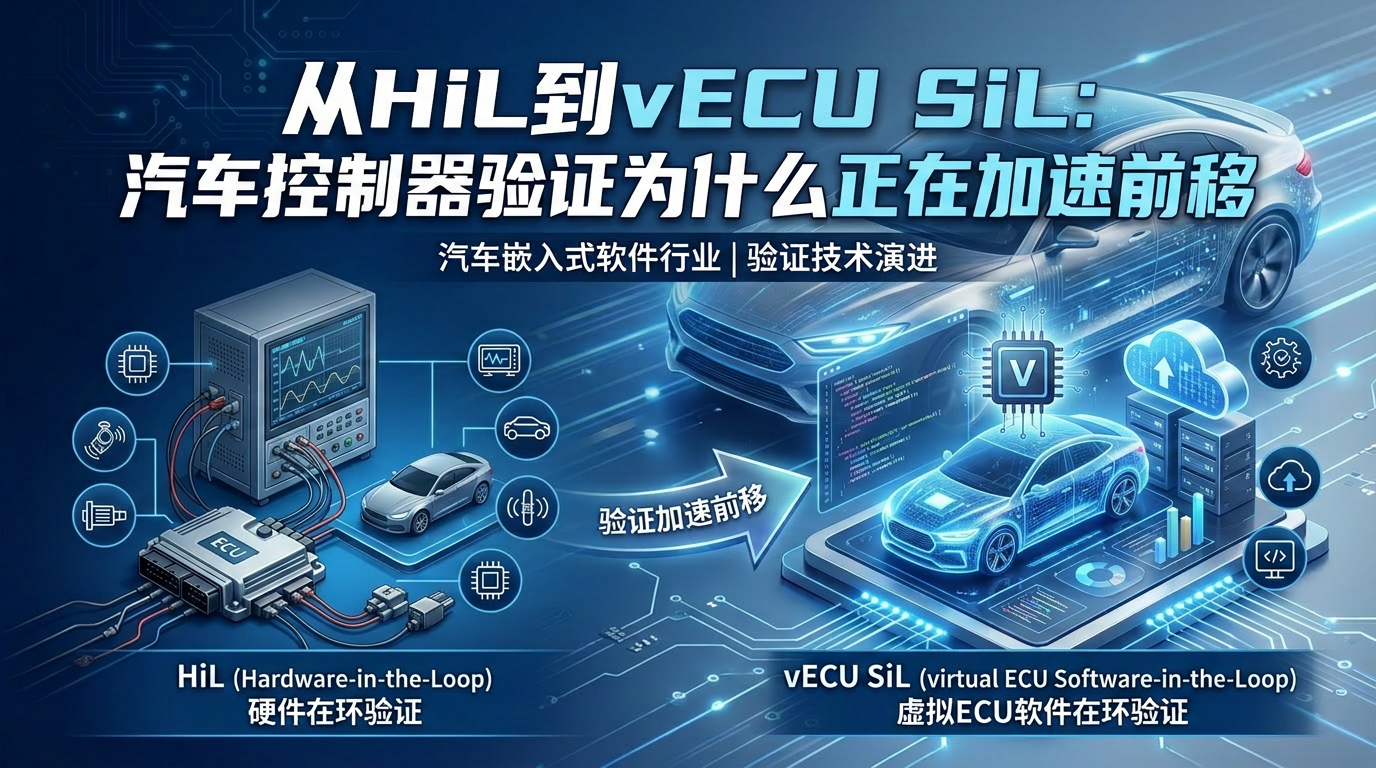
From HiL to vECU SiL: Why Automotive Controller Verification is Accelerating its "Shift-Left"
Summary:
Why is traditional HiL verification finding it increasingly difficult to keep up with the pace of software iteration?
What is the true value of vECU SiL, and why is it more than just "running an ECU on a PC"?
HiL will not disappear, but the division of verification labor is being redefined.
From testing tools to process capabilities: Why are enterprises rethinking vECU SiL?
More and more projects are moving verification activities forward—what is the driving force behind this?
When introducing vECU SiL, why is it unnecessary to pursue a "full-function virtual ECU" from the very beginning?
Project practice proves: What happens to the R&D rhythm after more verification is moved forward to SiL?
How should enterprises introduce vECU SiL in stages to ensure a stable implementation?
For OEMs and Tier 1s, where do the management and business values of vECU SiL lie?
How does Polelink help enterprises build a practical vECU SiL capability system?
In many current automotive electronic controller projects, the true anxiety for software teams is often not a "lack of testing," but rather that testing comes too late. Engineers must wait for hardware samples to be delivered, for HiL test benches, and for environment scheduling before testing, which means many problems are concentrated and explode during the mid-to-late stages of software distribution. Once software versions begin to iterate at high frequency, this hardware-centric verification rhythm easily becomes a bottleneck for R&D efficiency.
As "Software-Defined Vehicles" (SDV) continues to advance today, this contradiction is becoming more apparent. The rhythm of controller development is gradually shifting from "advancing around hardware samples" to "continuously evolving around software versions." This means the verification system must also evolve synchronously: which tests must rely on real hardware and which tests can be moved forward to an earlier software stage is becoming a question that more and more OEMs and Tier 1s must answer.
SiL (Software-in-the-Loop) based on vECU (Virtual ECU) has developed rapidly against this backdrop. Its value is not just about letting controller software "run on a PC," but more importantly, allowing verification activities to start earlier, forming a faster feedback loop, and gradually becoming a fundamental capability for enterprises to promote continuous integration, virtual prototype delivery, and collaborative R&D.
I. In the era of Software-Defined Vehicles, why must the software verification system change?
The automotive industry is undergoing a very clear change: vehicle competitiveness is increasingly determined by software rather than just mechanical and hardware configurations.
With the continuous advancement of intelligence, electrification, and platform-based development, the scale, complexity, collaborative development frequency, and update frequency of controller software are all rising rapidly. The past development rhythm based on software baseline milestones is being replaced by higher-frequency software version iterations. In this mode, if verification still highly relies on ECU samples, benches, and late-stage testing environments, then development efficiency, the speed of repair iterations, and the quality of released software versions will be significantly constrained, affecting the enterprise's product strength and competitiveness.
Why is the traditional verification method under increasing pressure?
From project practice, teams usually face several types of realistic problems:
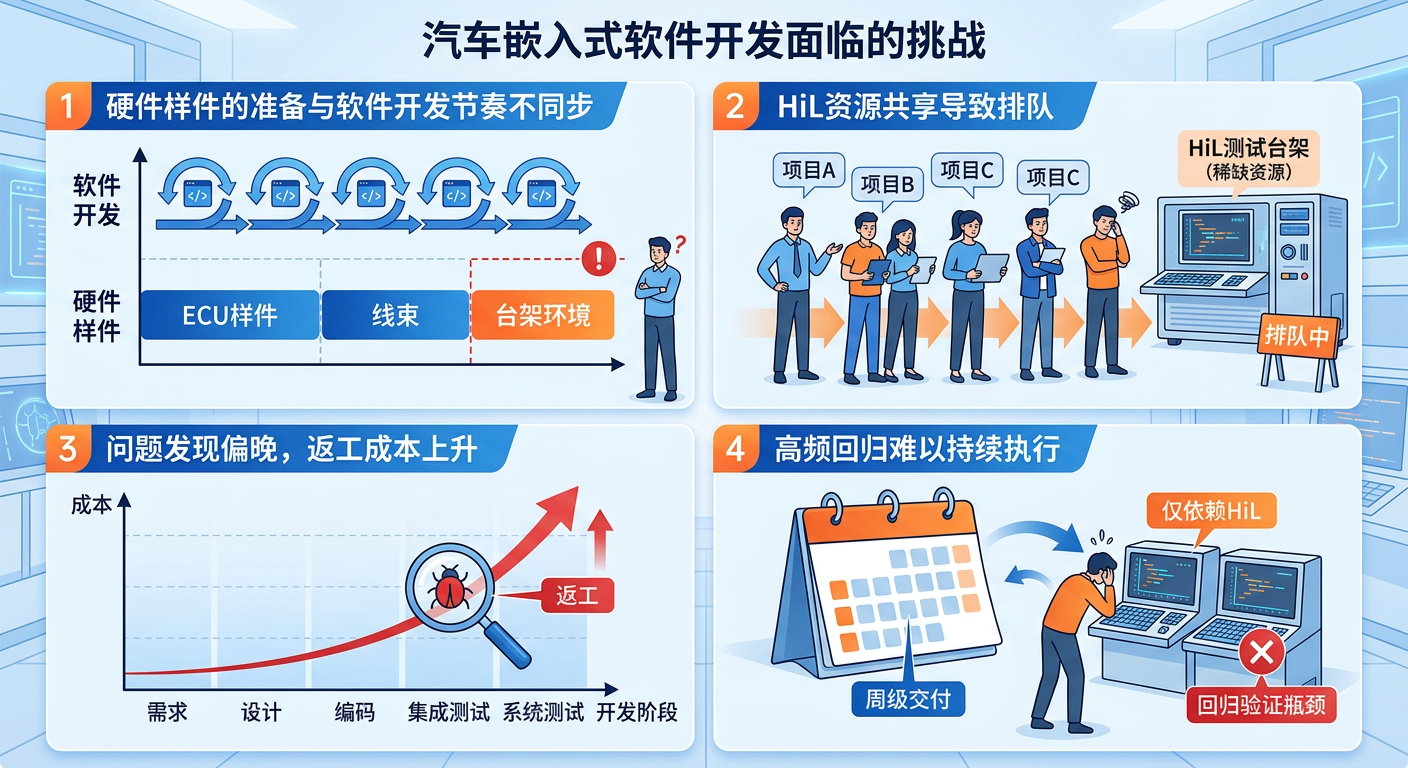
Hardware sample preparation is out of sync with software development rhythm: Software has already begun iterating, but many verification activities still need to wait for sample ECUs, wire harnesses, and test bench environments.
HiL resource sharing leads to queuing: In cases of parallel projects and multiple coexisting versions, HiL often becomes a scarce resource, affecting verification parallelism.
Late problem discovery increases rework costs: If logical problems are not exposed until the late integration stage, the cost of localization and repair increases significantly.
High-frequency regression is difficult to execute continuously: When software delivery reaches a weekly or higher frequency, relying solely on HiL makes it difficult to support large-scale, continuous regression verification.
In summary, this is not a problem with HiL itself, but rather that the R&D model has changed. When controller development enters the stage of high-frequency software iteration, the verification system must move toward "software shift-left verification."
II. The core value of vECU SiL: Not just virtualization, but hardware-software decoupling
Let's clarify the concepts first.
What is SiL?
SiL, or Software-in-the-Loop, refers to running the controller software under test in a software simulation environment to verify control strategies, algorithm logic, and partial software behavior without relying on real ECU hardware.
What is a vECU?
A vECU (Virtual ECU) is an executable virtual version of controller software in a PC or cloud environment. It usually retains some or all of the Application Software (ASW), RTE (if it is an AUTOSAR architecture), and partial BSW (Basic Software) behaviors, enabling development and testing teams to conduct functional verification and integration testing early without physical ECU samples. vECUs are divided into two types: one is an executable binary file compiled by a PC compiler, running in a PC or cloud environment; the other is a target file compiled based on the original target chip compiler toolchain, executed on a target chip emulator in a PC environment.
What is SiL based on vECU?
Simply put, it involves running the controller software in the form of a virtual controller in a PC or cloud environment, combined with plant simulation models, test cases, and automation processes to complete software-level verification.
From an engineering perspective, vECU-based SiL is not just "moving ECU software to a computer." Its more significant meaning lies in achieving partial hardware-software decoupling through virtualization, so that software development and verification are no longer completely bound to the same timeline as hardware preparation.
This change means:
Software teams can enter the verification state earlier.
Testing teams can execute regression tests faster.
Calibration and functional verification can be moved forward before samples are in place.
Software modifications do not always have to wait for full hardware environment deployment before verification can begin.
III. HiL is still important, but no longer suitable for all verification tasks
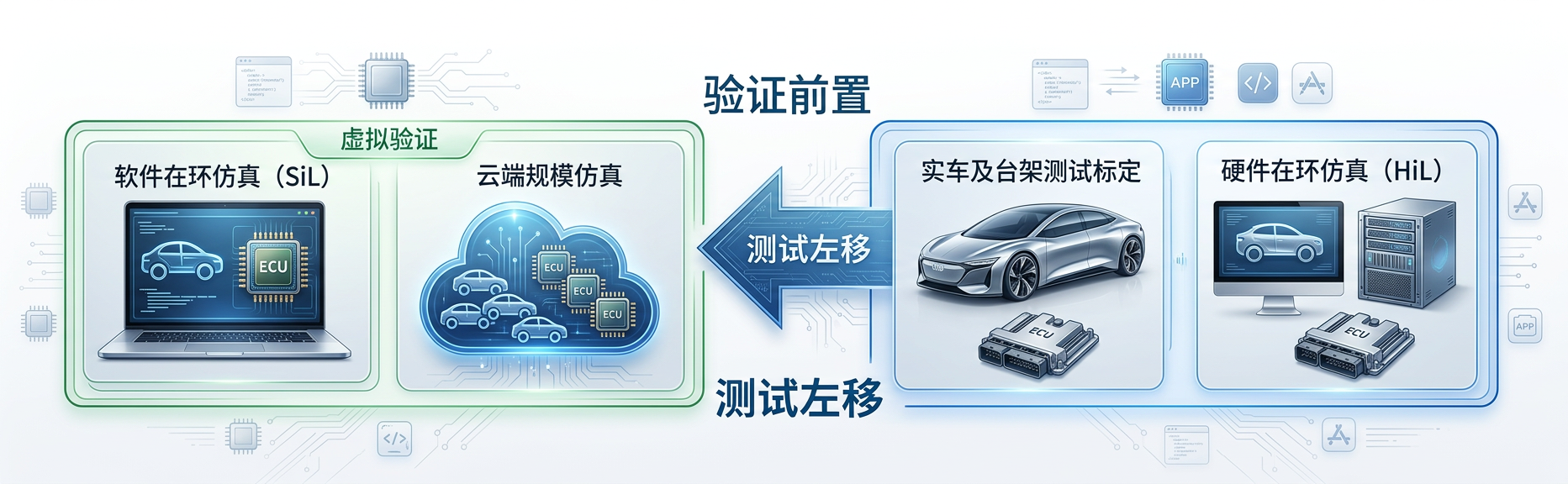
When discussing the value of SiL, a common misconception is to understand it as "replacing HiL." From engineering practice, a more reasonable understanding is: SiL is responsible for shifting left and diverging, while HiL is responsible for final oversight and convergence.
What is the difference in division of labor between HiL and vECU-based SiL?
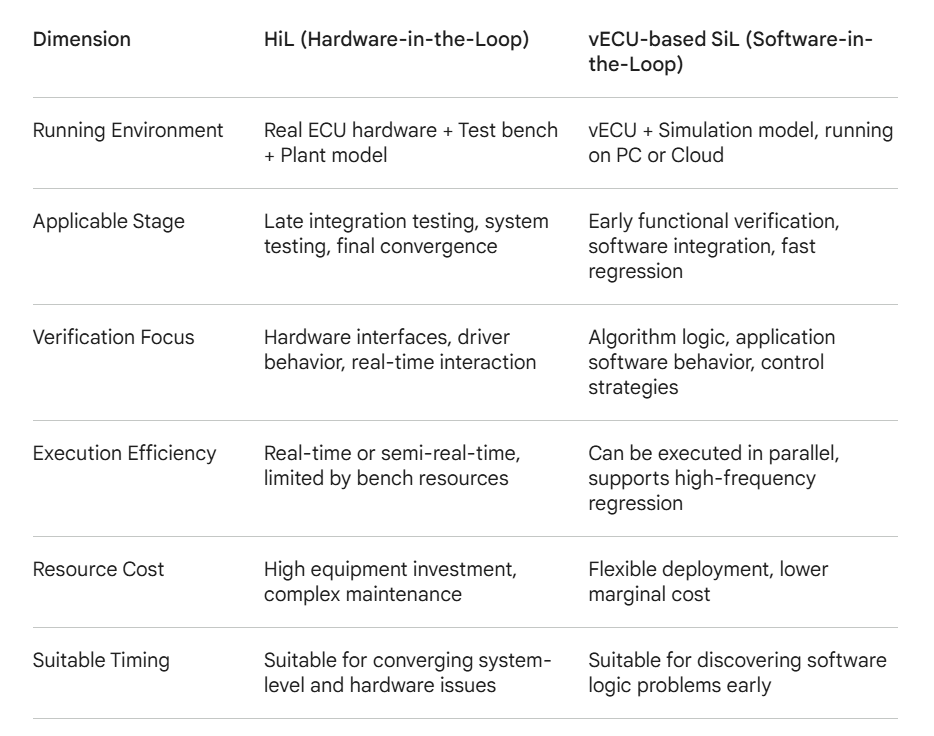
The most important conclusion is not to compare "which is better," but rather: Problems that can be found in the SiL stage do not need to wait for the HiL stage to be exposed.
What verification content is usually suitable for vECU SiL to cover?
Unit/module level testing
Software integration testing
Algorithm and control strategy verification
Virtual calibration and pre-calibration verification
Diagnostic and communication protocol verification
Regression testing of code parts after decoupling from hardware
What are the boundaries?vECU-based SiL is more suitable for covering control strategies, application logic, and software integration verification. However, software driver behavior and OS behavior strongly related to the target hardware are simulated; therefore, it cannot provide accurate time simulation of the microcontroller or support verifying Boot functions. Electrical interface-related issues still rely on HiL or the target hardware environment for convergence.
Mature enterprises typically use a "HiL + SiL multi-dimensional layered verification system."
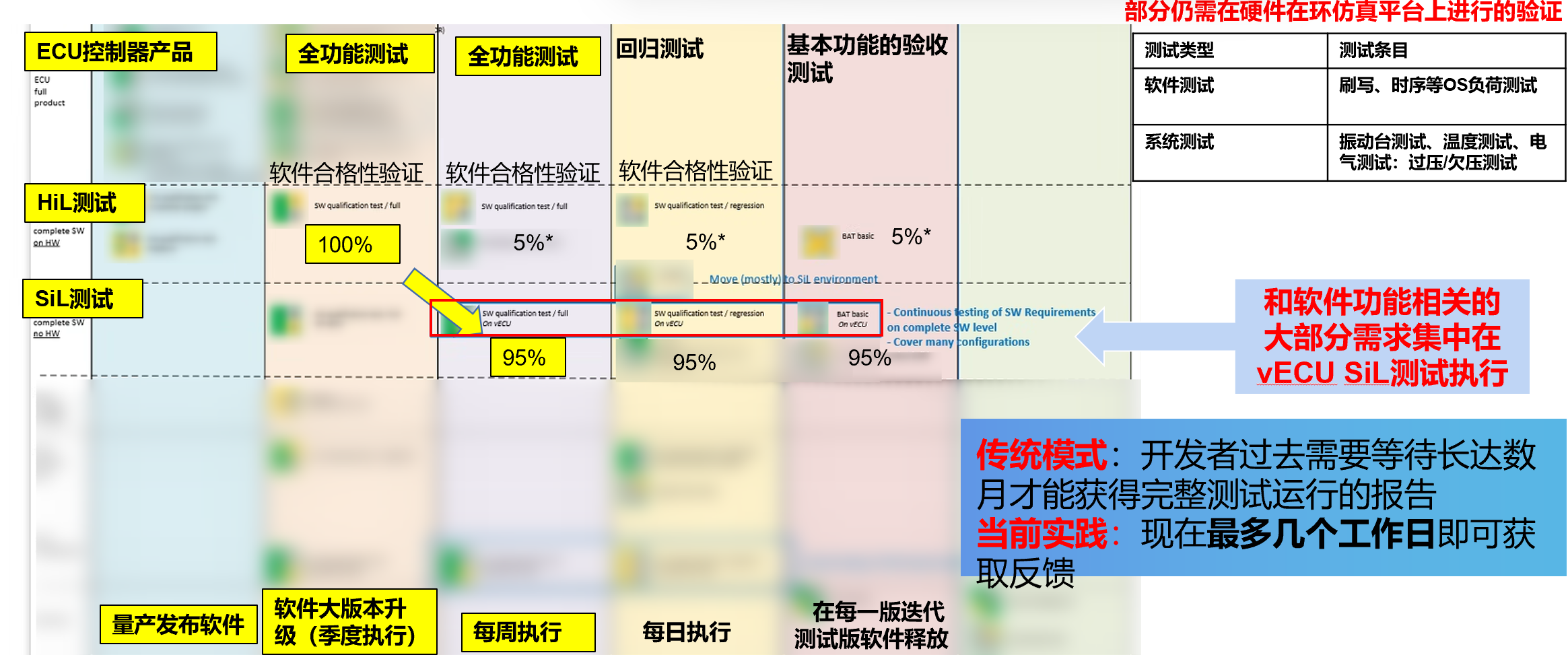
Division of labor between HiL and vECU-based SiL in the controller verification process
IV. Why do more enterprises see vECU SiL as a process capability rather than just a testing method?
Understanding vECU-based SiL merely as a tool underestimates its value. In the SDV context, its true significance lies in its ability to integrate into continuous development and verification processes.
What does it mean for agile development?When controller software versions begin high-frequency delivery, the team needs:
The ability to quickly build a verification environment after version changes.
Automatically executed smoke tests and regression tests.
Shifting problem feedback as far forward as possible.
Simultaneous support for multiple teams to collaborate in parallel.
vECU-based SiL is naturally suitable for integration into CI/CT (Continuous Integration/Continuous Testing) pipelines. This allows version building, automatic execution, and result analysis to form a repeatable closed loop.
What does it mean for corporate organizational synergy?
Software development teams verifying functions earlier and pushing them to market sooner.
Testing teams executing regressions at higher frequencies, with more efficient collaboration across functional departments.
Calibration teams conducting pre-calibration and virtual calibration with lower usage costs for sample cars and benches, as various software strategies have been verified in advance.
System testing teams performing multi-controller collaborative verification; this virtual SiL asset can accompany the entire life cycle of the vehicle configuration without dismantling and with minimal maintenance.
Cross-departmental and cross-project reuse of the same set of virtual prototypes and test assets (depending on the virtual prototype distribution mechanism and software collaborative development model based on virtual controllers).
From this perspective, the value of vECU-based SiL is no longer just about "increasing efficiency" but about helping enterprises reconstruct the verification rhythm and synergy methods.
V. Industry practice is proving: Verification activities are continuously shifting left
In more and more projects, the controller verification system is no longer "waiting for all hardware to arrive before centralized verification" but is instead unfolded in layers during the software development process.
Several clear drivers are behind this change:
Software version iterations are getting faster: With OTA, platform-based software development, and continuous evolution becoming the norm, controller software is no longer a "one-time development, one-time delivery" model. If verification cannot be performed at high frequency, it cannot support rapid software evolution.
Hardware resources cannot support parallel R&D: Sample ECUs, HiL benches, and specialized environments are limited resources. When multiple versions and teams advance in parallel, hardware dependence naturally slows down verification efficiency.
The later a problem is found, the higher the repair cost: If logical problems are not discovered until the HiL integration stage or even the actual vehicle stage, the localization path is longer, the impact is wider, and the rework cost is higher.
Virtual prototypes are becoming new synergy interfaces: In some advanced OEMs and supply chain systems, vECU virtual prototypes are no longer just internal test objects but are gradually becoming important carriers for front-end integration verification and supply chain collaborative delivery.
This indicates a clear trend: whoever can bring software into a verifiable state earlier will have a better chance of controlling the R&D rhythm.
VI. For project landing, a vECU does not necessarily need to reach "Level-3 full-function simulation" in one step
Many enterprises are interested in SiL but hesitate to start, often not because they don't recognize its value, but because they fear high price and technical thresholds or excessive modifications. In fact, from an engineering landing perspective, introducing vECU-based SiL does not have to start with "complete controller virtualization."
A more feasible approach is usually to advance in layers. Many projects start with the following objects, which are characterized by weak functional links with hardware:
Key functional packages
Control strategy modules or application layer software
By building a partial vECU first, the team can verify whether the following key capabilities are connected under a lower threshold:
Software build and virtualization process
Simulation environment and interface adaptation
Test case migration and automatic execution
Result analysis and problem localization methods
Confirmation of the collaborative model between teams
When these basic capabilities are stable, gradually expanding to more complete controller software or even multi-controller system-level collaborative verification is usually more stable and easier to gain internal organizational support.
VII. Project Practice: What does shifting more verification work forward to SiL bring?
What truly moves customers is never a PPT concept, but project results. In a power domain controller project of a domestic OEM, the team had long relied on HiL benches for version verification, but as software versions changed frequently, problems with resource tension and delayed feedback became increasingly obvious.
Core challenges faced by the project:
Fast software version updates and high pressure on HiL scheduling.
Hardware sample and environment preparation cycles affecting test start time.
A large number of logical problems concentrated and exposed during the late integration stage.
High version regression costs, making it difficult to support high-frequency iteration.
How did the verification method change after introducing vECU SiL?The team moved algorithm logic verification, software integration testing, and most regression testing forward to the vECU-based SiL environment, forming a layered strategy of "early SiL fast verification, late HiL focused convergence."
For some functional modules, the team did not build a complete virtual controller at the beginning, but first established a partial virtualized verification environment around key functional links, expanding the verification scope after connecting processes and interfaces.
Actual benefits brought:
Completed the vast majority of algorithm logic-related verification work before hardware samples arrived.
Discovered multiple software defects early that might otherwise have been exposed during the HiL integration stage.
Significantly reduced test bench rework caused by logical problems in the later stage.
Version regression efficiency improved significantly, and the verification feedback cycle was shortened remarkably.
Test assets were easier to accumulate and reuse for subsequent versions.
In this project, the team ultimately achieved the following results:
Reduced HiL test bench resource investment.
Test environment reconstruction time shortened from days to hours.
Specific version regression verification cycles were compressed.
Overall test costs were reduced (the deployment cost of a new set of SiL tool licenses is far lower than the hardware and software costs of HiL).
Improved test efficiency.
The key behind these benefits is not just "using fewer benches or test cars," but establishing a shorter defect feedback loop. For high-frequency software iteration projects, this is often more valuable than simply saving equipment costs.
VIII. How can enterprises smoothly introduce vECU-based SiL verification? The key is evolution, not replacement.
A stable path is usually not "one-step replacement of HiL" but starting from a controllable range and gradually building capabilities.
Stage 1: Starting from single controller and single functional packagePrioritize functional packages with clear algorithm logic and weak hardware dependence to build a basic vECU closed-loop verification environment. The focus of this stage is:
Connecting the software build and vECU generation process.
Establishing a basic simulation environment and interface adaptation; if there is a HiL plant model, SiL plant model closed-loop adaptation can be done.
Running core test cases through smoke tests in the virtual environment first to ensure consistency with hardware testing results, preparing for test shift-left.
Verifying whether the automated execution link is available.
Stage 2: Expanding from functional verification to integration verificationWhen single controller verification is stable, it can be gradually expanded to more software modules and multi-controller collaborative scenarios. This stage usually begins to focus on:
Integration of the first version of the virtual controller and batch processing automation decoupling scripts for the project.
Completing virtual A2L generation through address remapping and partial virtual calibration and pre-calibration verification.
Establishing a virtual network and extending to multi-controller virtual verification environment deployment.
Improving the accuracy of the plant model.
Connecting the CI/CT pipeline with the simulation platform to achieve automated regression testing.
Collaborative division of labor with the existing HiL process, moving some test functions forward to the SiL environment for verification.
Stage 3: Accumulating virtual prototype and process reuse capabilitiesA truly mature enterprise will not treat vECU as just a project environment but will incorporate it into the continuous delivery system. Key points include:
Establishing a standardized delivery mechanism for black-box or gray-box vECUs and connecting the OEM-Tier 1 integration platform.
Introducing a virtual verification management platform to support cross-team and cross-project verification collaboration.
Expanding to cloud-based parallel regression and large-scale testing scenarios when conditions are mature.
Walking to this step, the value of vECU-based SiL is no longer just about "increasing efficiency" but about helping the enterprise establish a more systematic software engineering capability.
IX. For OEMs and Tier 1s, where exactly does the value lie?
From management and business perspectives, introducing vECU SiL usually brings value concentrated in three layers:
R&D Efficiency Layer:
Starting verification earlier
Executing regressions faster
Shorter problem feedback cycles
Less restriction from sample and bench scheduling
Quality Control Layer:
Discovering logic and integration problems in advance
Reducing the risk of concentrated defect exposure in later stages
Improving verification coverage during the version iteration process
Collaborative Delivery Layer:
Supporting parallel collaboration among software, testing, calibration, and system teams
Supporting virtual prototype delivery and front-end supply chain collaboration
Providing basic verification capabilities for continuous integration and platform-based development
This is why more and more enterprises are beginning to realize that vECU-based SiL is not just a tool purchase or upgrade, but a change in the verification system and collaborative methods.
X. How Polelink helps enterprises build vECU-based SiL capabilities
For many enterprises, the real difficulty lies not in "knowing SiL software has value," but in "how to land it in the existing development process."
From engineering practice, if an enterprise wants to stably leverage the value of vECU-based SiL, it usually needs to connect several key links:
vECU virtual controller decoupling and construction, making "one configuration, multiple builds" a norm in software integration.
Closed-loop plant model adaptation.
Virtual verification simulation environment integration.
Establishment and deployment of CI/CT pipelines based on virtual verification SiL.
Deployment of virtual verification management and collaboration platforms.
Polelink Information focuses on automotive electronic controller virtualization and software verification solutions, helping customers gradually establish a capability system around these key links. This includes not only environment setup and verification support for projects but also process-oriented capability accumulation, helping enterprises move from single-point pilots to systematic applications.
Conclusion
In the era of Software-Defined Vehicles, software development speed is continuously increasing, and the verification system must evolve synchronously.
HiL remains important, but it is better suited for the final convergence of system-level and hardware-related issues; vECU-based SiL allows more software verification work to be moved forward to earlier stages.
This is not simply adding a testing method, but restructuring the verification rhythm in controller development.
Whoever can bring software into a verifiable state earlier will have a better chance of shortening the feedback loop, reducing rework costs, and maintaining R&D initiative during high-frequency iterations.
For enterprises promoting software platformization, continuous integration, and virtual delivery, vECU SiL is no longer just a direction "worth paying attention to," but is becoming an important component of competitiveness.
Polelink Information focuses on automotive electronic controller virtualization and software verification solutions, supporting enterprises in building landing capabilities from vECU generation and SiL verification to process integration, accelerating verification shift-left and improving software delivery efficiency.
In the next issue, we will present some specific cases to show in detail the practical solutions and application cases of vECU-based SiL. Stay tuned!